Table of Contents
C++ Tip Series
For all the code in this series, the repository is located here in the ‘cpp-tips’ directory. Look for the directory with the same name as the article’s title.
A Brief History of Smart Pointers
Smart pointers were influenced by C++‘s lack of garbage collection mechanism criticized by other popular languages like C#, Java, and Python. C++ responded by modernizing the language by introducing std::auto_ptr in c++98. Then in c++11, std::unique_ptr, std::shared_ptr, and std::weak_ptr pointers were published into the language. These smart pointers piggybacked on the c++98 idea of std::auto_ptr, and attempting to make smart pointers a little bit more robust.
Then inc++17, std::auto_ptr was depreciated — due to safety reasons — from the language and actively discouraged by C++ standard committee. C++ prides itself for always being backwards compatible, and the C++ committee recommends substituting std::auto_ptr with std::unique_ptr for c++17 and onward.
Supporting Topics Related to Smart Pointer
Before we examine smart pointers, we need to look into some supporting topic like static memory and raw pointers.
Static Memory
Before we talk about smart pointers, we need to understand static memory. Unlike dynamic memory, static memory doesn’t need the programmer’s intervention to implement. The scope of the memory gets created and destroyed automatically on the stack.
With static memory, it’s all about scope. After the variable’s lifetime is outside of the scope, the program will automatically free the data.
Here’s an example:
#include <iostream>
int main() {    int x = 2;    fprintf(stdout, "x: %ld\n", x);
    // creating a new scope    {        int y = 2 * x;        fprintf(stdout, "y: %ld\n", y);    } // y get deleted here automatically
    // y can't be printed out because program deletes it from the stack    // fprintf(stdout, "Value: %ld\n", y); // can't do this    fprintf(stdout, "x: %ld\n", x);
    return 0;}
The program takes care of the deletion of the memory on the stack in the case of static compile-time memory. Smart pointer share this fundamental idea of scoping, not the stack, but on the heap during run-time.
Proper Use of a Raw Pointer
Next is raw pointers, which have been in the languages since the beginning. Unlike smart pointers, raw pointer require you to create and free memory as well as manage the lifetime of the scope. Using the new/new[] or malloc/calloc and delete/delete[] keywords depending on the data type and if you’re using C or C++ style of memory allocation.
Here’s an example:
#include <iostream>
int main() {    int *value = new int{42}; // dynamic memory created    fprintf(stdout, "Value: %i", *value);
    int temp = 2 * (*value); // manipulating the value    fprintf(stdout, "Value: %i", temp);
    // with raw pointers, you must delete it when leaving the scope or a memory leak will occur    delete value;
    return 0;
Notice that the delete keyword is used once the programmer decides when the usage of value isn’t needed anymore. The programmer must maintain the usage of the delete keyword throughout the program or memory leaks will occur. However with smart pointers, maintaining the delete isn’t necessary anymore!
Use Cases of Smart Pointers
Smart pointers prevents the following issues:
- eliminates deleting a pointer twice
- prevents dangling pointers from occurring
- decreases certain memory leaks
Smart pointers are basically a rudimentary form of garbage collection and eases the programmer from manually managing every single part of computer memory. Smart pointers ultimately makes C++ safer to program.
Deleting a Pointer Twice
Trying to delete a pointer twice, which can occur in large codes bases, will cause and error. The program expects to delete the resource, but nothing is there, the program sees this undefined behavior and crashes.
Here’s an example:
int main() {    int *pointer = new int{100}; // creating a pointer
    delete pointer; // allowed -- resource deleted    delete pointer; // error -- program crashes during run-time
    return 0;}
Because the compiler doesn’t catch this logical issue and effectively causes the program to crash on run-time. This should always be avoided. Smart pointers will prevent the programmer from accidentally deleting the pointer twice.
Dangling Pointers
A dangling pointer occurs when a pointer references a memory address that has been deleted by another pointer.
Let’s illustrate this example:
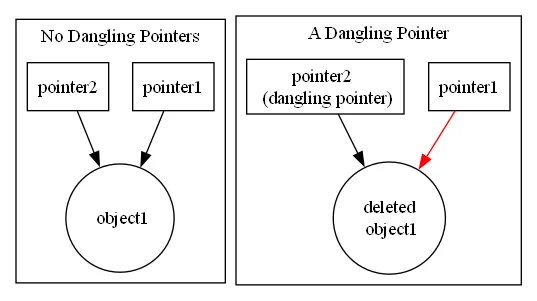
As we can see in the figure above, we have “pointer1” and “pointer2” pointing to “object1” in the “No Dangling Pointer” subgraph. Let’s suppose that “pointer1” deletes the memory address its pointer to. In the “A Dangling Pointer” subgraph, that action causes “pointer2” to become a dangling pointer. It references something that doesn’t exist or has a “dangling” reference.
Dangling pointers is a sign of memory leak, however we can avoid dangling pointer memory leaks by implementing std::weak_ptr at opportunistic situations. More on std::weak_ptr later.
Memory Leaks
In the context of memory leaks, continuously creating a heap-allocated raw pointer without ever deleting the memory, is a form of stability memory leak. The memory keeps on growing without dellocating the resources effecting the the long-term usability.
Here’s an example:
#include <iostream>
int main() {    {        // creating value        int *value = new int{42};        fprintf(stdout, "Value: %i\n", *value);
        // memory leak -- didn't delete or free out-of-scope memory    }
return 0;}Now lets use Cpp-Check — a static analyzer — to verify that a memory leak occurred.

As we can see, a memory leak occurred, however using smart pointers and help eliminate manual memory management and prevents memory leaks when the programmer forgets to use the delete keyword at important moments. In this case, delete wasn’t used at all.
Smart pointers effectively help with memory leak issues. It’s necessary for programs to have zero memory leaks. If memory isn’t allocated and deallocated correctly, the program my crash due to the program’s lack of available resources. Ultimately, affecting the reliability, performance, and stability of the program, and for embedded systems that may run for years without a reboot. (Wikipedia contributors, 2026)
In an article by Kellett, there are 19 common memory leaks in C++. Kellett illustrates why and how they occur and a solution to fix them. Memory leaks are another topic related to smart pointers; however, we will take a look at some examples on the way, but only give some examples for purpose of this article. For more information on specific memory leaks, refer to Kellett or other references. (Kellett, 2025)
Smart Pointers
As we’ve seen previously, memory leaks and program crashes can occur. However with smart pointers, it automatically deallocates objects resource or prevents fatal programming conditions and states. Smart pointers are a blessing for C++ safety!
In order to use the smart pointers, you must include <memory> library in your program, which gives you access to unique, shared, weak, and auto pointers.
Unique Pointer (std::unique_ptr)
Unique pointer is the c++11’s revised definition of a smart pointer, which helps facilitate memory ownership. When using unique_ptr, only one object can be the “owner” of the data explicit, which means it can’t be copied, but it can be moved using std::move. However, the “owner” has the responsibility to delete the object, and it will occur once the object is out of scope (GeeksforGeeks, 2025).
Unique Pointer Syntax
// pointer initializationunique_ptr<SomeType> u;
// not preffered because doesn't implement exception safetyunique_ptr<SomeType> u(new <SomeType>);unique_ptr<int> u(new int{1}); // example
// pointer initialization with (right side) new-expression -- exception safety enabledunique_ptr<SomeType> u = std::make_unique<SomeType>(<constructor & parameters here>);unique_ptr<int> u = std::make_unique<int>(int{1}); // example
Important Unique Pointer Member Functions
The following are some important member functions when using the std::unique_ptr:
| Method | Description |
|---|---|
pointer release() | Releases the ownership of the managed object, if any. |
void reset(ptr) | Replaces the current pointer with ptr. |
void swap(ptr) | Swaps the current object (and delete it) and changes unique_ptr object to ptr. |
pointer get() | Returns a pointer to the managed object or nullptr if no object is owned. |
Unique Pointer Member Function Examples
#include <memory>#include <iostream>
int main() {    // release() example    std::unique_ptr<int> value1 = std::make_unique<int>(int{ 1 }); // value1 = 1    fprintf(stdout, "value1: %d\n", *value1);    value1.release(); // value1 = nullptr
    // reset() example    std::unique_ptr<int> value2 = std::make_unique<int>(int{ 2 }); // value2 = 2    fprintf(stdout, "value2: %d\n", *value2);    // releasing the current pointer and replacing it with a new one of value 22    value2.reset(std::make_unique<int>(int{ 22 }).release()); // value2 = 22    fprintf(stdout, "value2: %d\n", *value2);
    // swap() example    std::unique_ptr<int> value3 = std::make_unique<int>(int{ 3 }); // value3 = 3    std::unique_ptr<int> value4 = std::make_unique<int>(int{ 4 }); // value4 = 4    fprintf(stdout, "value3: %d\n", *value3);    fprintf(stdout, "value4: %d\n", *value4);    value3.swap(value4); // value3 = 4 , value4 = 3    fprintf(stdout, "value3: %d\n", *value3);    fprintf(stdout, "value4: %d\n", *value4);
    // get() example    std::unique_ptr<int> value5 = std::make_unique<int>(int{ 5 }); // value5 = 5    fprintf(stdout, "value5: %d\n", *value5);    int* rawPtr = value5.get(); // rawPtr = 5    fprintf(stdout, "rawPtr: %d\n", *rawPtr);
    return 0;}
Unique Pointer Example — Can’t be Copied, but Move is Allowed
In this example, it shows that the unique pointer can’t be copied but can be transferred:
#include <memory>#include <iostream>
int main() {    std::unique_ptr<int> value1 = std::make_unique<int>(int{ 10 });    fprintf(stdout, "value1: %d\n", *value1);
    // compiling error can't copy value1 into value2    // std::unique_ptr<int*> value2 = value1;
    // allowed    std::unique_ptr<int> value2 = std::move(value1); // value1 = nullptr    fprintf(stdout, "value2: %d\n", *value2);
    return 0;}
Shared Pointer (std::shared_ptr)
Shared pointer, unlike unique pointer, allows multiple “ownership”, but once the pointer count goes to zero, then the object’s memory is freed or deallocated. std::shared_ptr has some member variables/functions that internally increment/decrements the number of std::shared_ptr’s references pointing to that memory address. In other words, there’s an agreement that once there are no references, then the shared pointer will be automatically released.
Shared Pointer Syntax
// pointer initializationshared_ptr<SomeType> s;
shared_ptr<SomeType> s(new <SomeType>{});
// pointer initialization with (right side) new-expressionshared_ptr<SomeType> s = std::make_shared<SomeType>({constructor & parameters here});
Important Shared Pointer Member Functions
The following are some important member functions when using the std::shared_ptr:
| Method | Description |
|---|---|
void reset(ptr) | Replaces the managed object with an object pointed to by ptr. |
void swap(ptr) | Swaps the current objects. Reference counts, if any, are not adjusted. |
T* get() | Returns the stored pointer, not the managed pointer. |
long use_count() | Returns the number of shared_ptr objects referring to the same managed object. |
bool unique() | Checks whether the managed object is managed only by the current shared_ptr object. |
Shared Pointer Member Function Examples
#include <memory>
int main() {    // reset example    std::shared_ptr<int*> value1 = std::make_shared<int*>(new int{42}); // value1 = 42    std::shared_ptr<int*> value2 = std::make_shared<int*>(new int{24}); // value2 = 24    value1.reset(value2.get()); // value1 = 42  value2 = 42
    // swap example    std::shared_ptr<int*> value3 = std::make_shared<int*>(new int{ 1 }); // value3 = 1    std::shared_ptr<int*> value4 = std::make_shared<int*>(new int{ 11 }); // value4 = 11    value3.swap(value4); // value3 = 11  value4 = 1
    // get example    std::shared_ptr<int> value0 = std::make_shared<int>(42); // value0 = 42    int* rawPtr = value0.get(); // rawPtr = 42
    // use_count example    std::shared_ptr<int*> value5 = std::make_shared<int*>(new int{ 5 }); // value5 = 5    std::shared_ptr<int*> value6 = value5;    std::shared_ptr<int*> value7 = value5;    fprintf(stdout, "use_count: %d\n", value5.use_count()); // count = 3    value7 = nullptr;    fprintf(stdout, "use_count: %d\n", value5.use_count()); // count = 2    value6 = nullptr;    fprintf(stdout, "use_count: %d\n", value5.use_count()); // count = 1
    // unique example    std::shared_ptr<int*> value8 = std::make_shared<int*>(new int{ 8 }); // value8 = 8    std::shared_ptr<int*> value9 = value8;    fprintf(stdout, "isUnique?: %d\n", value8.unique()); // 0 (false)    value9 = nullptr;    fprintf(stdout, "isUnique?: %d\n", value8.unique()); // 1 (true)
    return 0;}
Weak Pointer (std::weak_ptr)
Weak pointers can be thought as similar to a std::shared_ptr, however there isn’t a strong reference (has ownership) but a weak reference (doesn’t have any ownership) to the memory address. What this means it’s a non-owning pointer that doesn’t increase the std::shared_ptr reference count.
Another use case of std::weak_ptr is to prevent cyclical dependencies. Let’s say that object1 references object2 and object2 references object1. Let’s say that object1 released its memory, so object2’s reference is invalid and will reference a nullptr. Manipulating object2 will make the program crash.
However, using std::weak_ptr can eliminate this issue. By using std::weak_ptr’s member function lock() and expired(), we can check if a reference’s memory has been released, and if it’s been released, don’t do anything.
We will look at a concrete example in the cyclical dependency section below.
Weak Pointer Syntax
// pointer initialization -- points to nothingweak_ptr<SomeType> w;
// weak pointers must be initialized and reference to a shared_ptrweak_ptr<SomeType> w(<SomeSharedPtr>);weak_ptr<SomeType> w = <SomeSharedPtr>;
Important Weak Pointer Member Functions
The following are some important member functions when using the std::weak_ptr:
| Method | Description |
|---|---|
void reset(ptr) | Replaces the managed object with an object pointed to by ptr. |
void swap(ptr) | Swaps the current object (and delete it) and changes weak_ptr object to ptr. |
bool expired() | Checks whether the referenced object was already deleted. |
std::shared_ptr<T> lock() | Creates a shared_ptr that manages the referenced object. |
long use_count() | Returns the number of weak_ptr objects referring to the same managed object. |
Weak Pointer Member Function Examples
#include <memory>#include <iostream>
int main() {    // reset() example    std::shared_ptr<int> value1 = std::make_shared<int>( int{1} ); // value1 = 1 (1 strong)    std::weak_ptr<int> wValue1{ value1 }; // wValue1 = 1 (1 strong, 1 weak)    wValue1.reset(); // (1 strong)
    fprintf(stdout, "value1: %d\n", value1.use_count()); // count = 1    fprintf(stdout, "wValue1: %d\n", wValue1.use_count()); // count = 0
    // swap() and lock() example    std::shared_ptr<int> value2 = std::make_shared<int>(int{ 20 }); // value2 = 20    std::shared_ptr<int> value3 = std::make_shared<int>(int{ 30 }); // value3 = 30    std::weak_ptr<int> wValue2{ value2 }; // wValue2 = 20    std::weak_ptr<int> wValue3{ value3 }; // wValue3 = 30    wValue2.swap(wValue3); // wValue2 = 30, wValue3 = 20
    fprintf(stdout, "wValue2: %i\n", *wValue2.lock()); // wValue2 = 30    fprintf(stdout, "wValue3: %d\n", *wValue3.lock()); // wValue3 = 20
    // expired() example    std::weak_ptr<int> wValue4; // wValue4 = nullptr
    // creating a new scope    {        std::shared_ptr<int> value4 = std::make_shared<int>(int{ 40 }); // value4 = 40        wValue4 = value4; // wValue4 = 40
        if (!wValue4.expired()) std::cout << "wValue4 is valid\n";        else std::cout << "wValue4 is expired\n";    } // shared pointer get deleted -- out of scope
    if (!wValue4.expired()) std::cout << "wValue4 is valid\n";    else std::cout << "wValue4 is expired\n";
    // use_count() example    std::shared_ptr<int> value5 = std::make_shared<int>(int{ 5 }); // value5 = 5 (1 strong)    std::weak_ptr<int> w1Value5{ value5 }; // w1Value5 = 5 (1 strong, 1 weak)    std::weak_ptr<int> w2Value5{ value5 }; // w2Value5 = 5 (1 strong, 2 weak)
    // weak pointer does not increase the reference count, only shared pointer do.    fprintf(stdout, "w1Value5 -- use_count: %d\n", w1Value5.use_count()); // count = 1    w2Value5.reset(); // w2Value5 == nullptr (1 strong, 1 weak)
    // shared pointer increment count    std::shared_ptr<int> s1value5 = value5; // value5 (2 strong, 1 weak)    fprintf(stdout, "w1Value5 -- use_count: %d\n", w1Value5.use_count()); // count = 2
    return 0;}
Weak Pointer Example — Eliminating Cyclical Dependencies
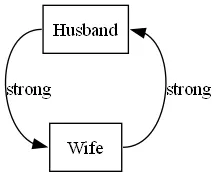
As seen in the diagram below, follow the strong pointer (black arrow) until it reaches the end node. When you have strong pointers pointing to each other, they go around referencing themselves and continuing to find an ending. However you see there isn’t one.
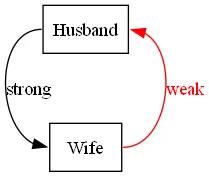
However in the solution case — see the diagram below — using a weak pointer breaks the cycle. Think of it that the red “weak” pointer is imaginary to the system, but you the programmer knows it’s there. When you start at husband object, it stops at the wife object breaking the cycle.
Cyclical Dependency Problem Example
Illustrating strong pointers causes cyclical dependency.
#include <memory>#include <iostream>
class Wife;class Husband;
class Wife{public:  ~Wife() { fprintf(stdout, "Wife destructor called\n"); }  std::shared_ptr<Husband> pHusband;};
class Husband{
public:  ~Husband() { fprintf(stdout, "Husband destructor called\n"); }  std::shared_ptr<Wife> pWife;};
int main() {  {    std::shared_ptr<Husband> husband = std::make_shared<Husband>(); // (1 strong)    std::shared_ptr<Wife> wife = std::make_shared<Wife>(); // (1 strong)
    // creating cyclical dependency    husband->pWife = wife; // (2 strong)    wife->pHusband = husband; // (2 strong)
    // use_count function counts strong ptrs    fprintf(stdout, "wCount: %d\n", husband->pWife.use_count());    fprintf(stdout, "hCount: %d\n", wife->pHusband.use_count());  }
  // pointer never get delete outside this scope
    return 0;}
Cyclical Dependency Solution Example
Using a weak pointer to solve cyclical dependency.
#include <memory>#include <iostream>
class Wife;class Husband;
class Wife{public:  ~Wife() { fprintf(stdout, "Wife destructor called\n"); }  std::weak_ptr<Husband> pHusband; // weak ptr};
class Husband{public:  ~Husband() { fprintf(stdout, "Husband destructor called\n"); }  std::shared_ptr<Wife> pWife;};
int main() {  {    std::shared_ptr<Husband> husband = std::make_shared<Husband>();    std::shared_ptr<Wife> wife = std::make_shared<Wife>();
    husband->pWife = wife; // (2 strong)    wife->pHusband = husband; // (1 strong, 1 weak)
    // use_count function counts strong ptrs    fprintf(stdout, "wCount: %d\n", husband->pWife.use_count());    fprintf(stdout, "hCount: %d\n", wife->pHusband.use_count());  }
  // 1 strong reference to husband, which cause the smart pointer to delete...  // since the deletion of the husband reference decrements the wife reference by 1...  // that then deletes the wife smart pointer
    return 0;}
Auto Pointer (std::auto_ptr)
Don’t use auto_ptr, it was removed and depreciated from C++, because it’s known to lead to errors. Seriously don’t use it. However… there are some cases to use std::auto_ptr when working with C++ prior to c++11, but this topic is out of scope in this article. If you use it, beware of your safety and sanity.
Summary
Smart pointers allow and prevent the following issues:
- automatic deletion of memory once smart pointer is out of scope
- prevents deleting pointer more than once
- helps manage dangling pointers
- creates the concept of ownership
- eliminates cyclical dependencies
- promotes code safety
Smart pointers are a wrapper around raw pointers, which comes with other specific member function to help with development. Always lean towards using smart pointers instead of raw pointer. Smart pointers give you better control and prevents common errors in your codebase!
Smart Pointer Summary — Table (UncomplicatingTech, 2025)
The following table helps with the overall summary of smart pointers. Ownership and count reference should be stressed here for some key characteristics for smart pointers.
| Pointer Type | Ownership | Reference Count | Auto Delete | Use Case(s) | Notes |
|---|---|---|---|---|---|
std::unique_ptr | yes | 1 | yes | exclusive ownership | copies forbidden; moves allowed |
std::shared_ptr | yes | shared count | yes | multiple owners | |
std::weak_ptr | no | none | no | avoiding circular references, non-owning |
Cited Resources
Wikipedia contributors. (2025, November 21). Smart pointer. Wikipedia. https://en.wikipedia.org/wiki/Smart_pointer
Kellett, S. (2025, November 4). Memory leak example: Understanding the nineteen types. Software Verify. https://www.softwareverify.com/blog/the-nineteen-types-of-memory-leak/
Wikipedia contributors. (2026, May 24). Memory leak. Wikipedia. https://en.wikipedia.org/wiki/Memory_leak
GeeksforGeeks. (2025, July 23). unique_ptr in C++. GeeksforGeeks. https://www.geeksforgeeks.org/cpp/unique_ptr-in-cpp/
UncomplicatingTech. (2025, April 2). Weak pointers made simple: Avoid shared pointer traps in C++ [Video]. YouTube. https://www.youtube.com/watch?v=xHS6YVttLJ0