# Uniform Initialization
Table of Contents
C++ Tip Series
For all the code in this series, the repository is located here in the ‘cpp-tips’ directory. Look for the directory with the same name as the article’s title.
What is Uniform Initialization?
Uniform Initialization is a new feature in C++11 that allows a different syntax to initializing variables and primitive types by using the braces {} instead of the parenthesis () (GeeksforGeeks, 2023). However, it isn’t just another trivial way to initialize, it also has the mechanism to enforce safety checks.
The uniform initialization safety checking characteristics are:
- Prevents type conversation narrowing
- Guarantees initialization
C++ Initialization
Throughout C/C++‘s history, initialization has been categorized into seven different groups (Meeting Cpp, 2019):
- Default Initialization (no initializer)
- Copy Initialization (’= value’, pass-by-value, return-by-value)
- Aggregate Initialization (’= {args}’)
- Direct Initialization (argument list in parentheses)
- Value Initialization (empty parents)
- List Initialization (‘{args}’ in direct-list-init, ’= {args}’ in copy-list-init)
- Uniform Initialization (‘{value}’, {})
There are multiple ways of initialization variables and classes, here are just a few examples:
int x; // default initializationint x = 10; // value/direct initializationint x = &y; // copy initializationint x[3] = { 4,5,6 } // aggregate initializationint x(7); // direct initializationint x{}; // uniform initializationint x{10}; // uniform initialization
X x1(); // default constructorX x2(1); // parameterized constructorX x1 = x2; // copy-constructor initialization
std::vector<int> vector{ 1,2,3,4,5 } // initializer list
Examples of Safety Checks
Let’s take a look at type conversation narrowing and guarantees initialization and the safety part of uniform initialization.
Prevents Type Narrowing
What is type narrowing? It’s the process of taking a broader type and converting it into a more specific type, which usually leads to loss of type information.
int main() {  int a{2}; // okay  int b = 3.9; // okay -- but type narrowing occurs  int c(4.2); // okay -- but type narrowing occurs  int d{2.3}; // error -- narrowing from double to int
  return 0;}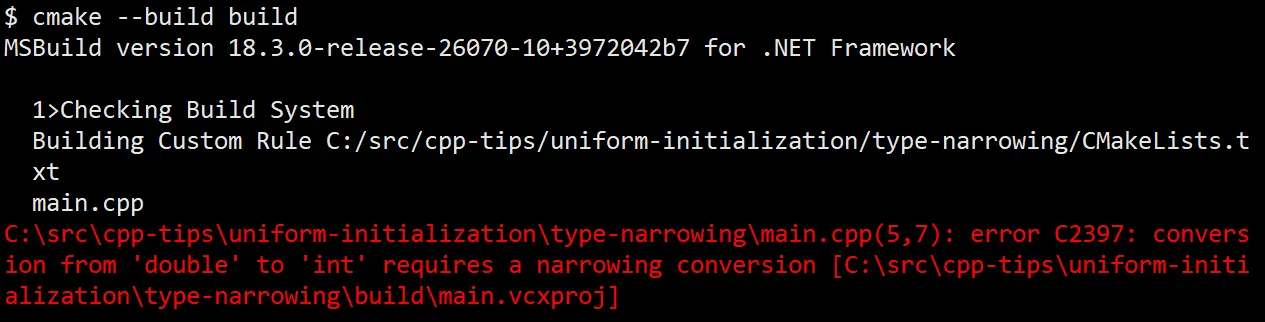
Guarantees Initialization
Unlike any other initialization, uniformed initialization will promise a zero or NULL (“0”) if nothing is declared.
Here are some examples:
int main() {    int a; // okay -- will be populated with any unknown int value    int b(); // nothing gets initialized    int c(3); // okay    int d{}; // okay -- guarantees an initialized value of "0"    int e{5}; // okay
    return 0;}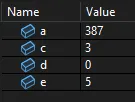
As we can see from the “debugging results” figure, variable “a” happens to be initialized with an integer value of “387”. C++ doesn’t promise any particular value, so it could be any integer value. Additionally, variable “b” wasn’t created at all, which is an issue related to C++ safety. Using the uniform initialization prevents these errors from occurring.
Summary
Use uniform initialization whenever possible, because initializing variables or classes with “garbage” values or completely nothing is an issue you want to avoid. Uniform initialization will throw a compiling error if something is wrong and catching it before it turns into a run-time error. Moreover, C++ has an ideology to prevent or eliminate undefined behaviors and uniform initialization supports “safe, healthy, and efficient” programming (Safe C++, 2024).
Resources
GeeksforGeeks. (2023, February 13). Uniform initialization in C++. GeeksforGeeks. https://www.geeksforgeeks.org/cpp/uniform-initialization-in-c/
Meeting Cpp. (2019, January 26). Initialization in modern C++ - Timur Doumler - Meeting C++ 2018 [Video]. YouTube. https://www.youtube.com/watch?v=ZfP4VAK21zc
Safe C++. (2024, September 11). https://safecpp.org/draft.html